For years, aspiring designers and small brand owners have emailed me the same question: “How do I get noticed as a fashion designer?”
It’s a topic I’ve wanted to touch on for a long time. I finally made a post about it on my Instagram page, but here I want to get into more details.
Why do some designers get all the opportunities and invitations to celebrate their designs, while others hardly get noticed by anyone?
Talking about this might trigger some emotions, and I’m not saying I approve of it or that it’s fair.
But the reality is that the most talented people don’t always get noticed. It’s often the loudest ones and the ones who know how to build the right impression.

Three keys to get noticed as a fashion designer:
1. Fashion Is About Looks
Accept that fashion can be superficial. And that’s not a bad thing. The fashion industry works and sells the looks, the beauty, the illusion.
Not that you can’t make a political statement with your outfit or express deep beliefs, but if we have to be honest – runways are rarely this deep. It’s mostly about the beautiful, dreamy looks.
It’s about using clothes and styling to our advantage to trick the eye into thinking we are taller, slimmer, curvier, and whatever the current fashion/beauty trend is this decade.
2. Fashion Is About Marketing
By marketing, I mean the ability to make something or somebody more attractive and more expressive, more desirable.
It’s about letting clothes speak for the person and communicate a big chunk of their values and beliefs.
It’s about showing what we’ve got (physically and internally) in the best lighting.
All this fashion marketing happens with more visuals and fewer words, because visuals are the language of clothes.
3. Fashion Is About Selling Ideas
This is where we get back to our initial question – why do some designers get noticed, but others don’t, and what can we do to be in the right group?
The answer is simple – successful designers market their ideas better. And it’s a long cycle:
- A fashion design is marketed to you via the storefront window or the way it was displayed in the
store. - Before that, it was marketed to you via a photoshoot in a magazine or in an ad you caught online.
- Before that, it was marketed to celebrities and buyers on the runways and exhibitions.
- Before that, it was marketed to the people making decisions in a fashion brand as a simple concept, a fashion sketch.
If this initial sketch was well received – it walked all the long way to the customer’s wardrobe. If the presentation wasn’t enough – the idea died right then and there.
Your Choice
So if you really wish to see your ideas sold, worn, and sought after, you need to understand that you are in control of the first and most important step of the process – how you present your design.
If you slack and get lazy with the presentation – chances are your design will have to work triple as hard to be noticed.
But if you know how to market your idea – how to make even a simple black dress shine with the right styling, the right rendering technique, and the right amount of detail – chances are everything will become easier.
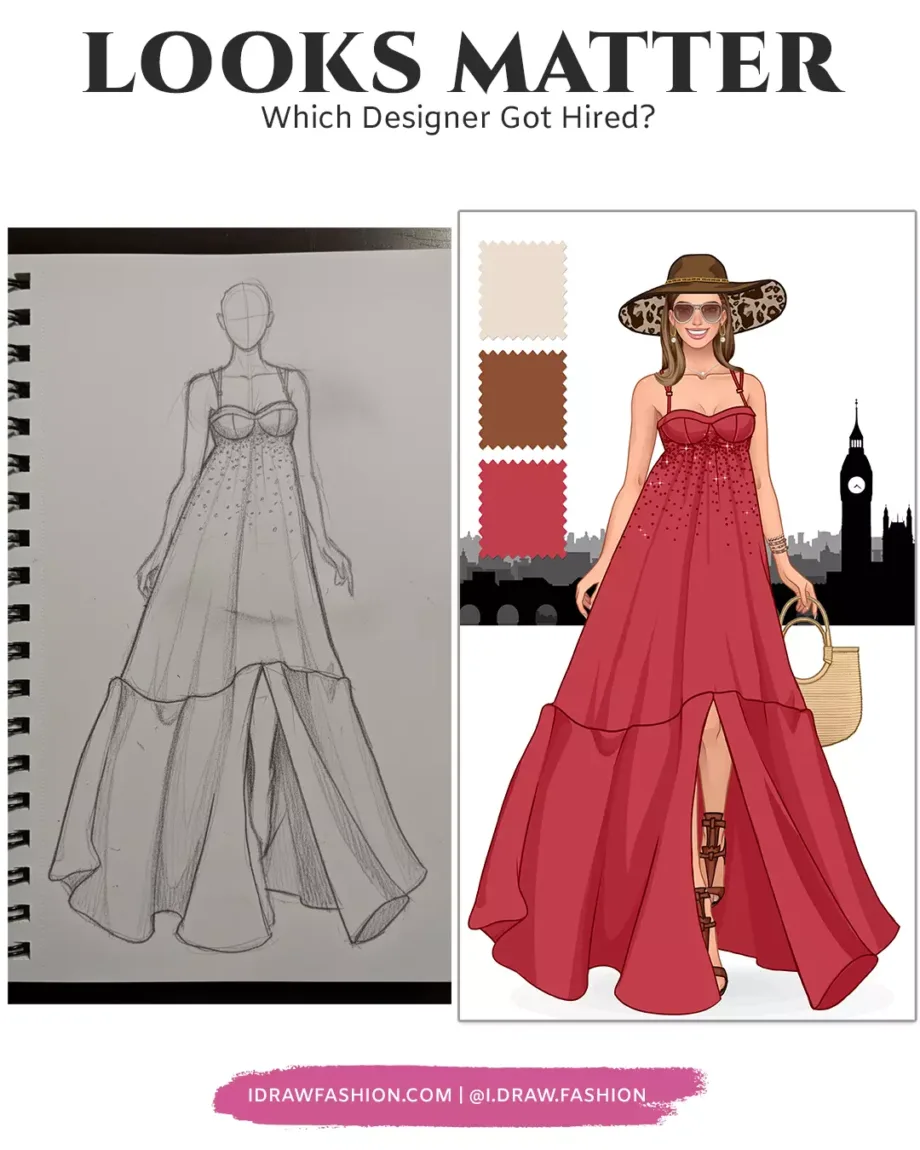
Take a look at this dress, presented with minimal effort versus more effort. The difference is not in the dress design – it’s how it was marketed to you.
But solely because of the presentation, you’re able to answer all these questions:
- 👉 Which designer has more experience?
- 👉 Which designer is better paid?
- 👉 Which designer is more trustworthy?
- 👉 Which designer has a better work ethic?
- 👉 Which designer better understands the body, fabrics, and styling?
- 👉 Which designer got hired by a big fashion brand?
And if you’re able to answer these questions based only on one sketch, trust me – people looking to hire a designer can do so too.
What To Focus On:
So now that you know high-quality fashion sketches open doors for you, let’s see what you need to focus on.
👉 Model Anatomy – perfect face, hands, and proportions.
👉 Technique – preferably digital, so different colorways are quick and easy to create. Time is king.
👉 Fabric rendering – different fabrics, stitching, and embellishments done with precision.
👉 Folds – placed in the right locations. A design that looks too stiff or too wrinkly is bad.
👉 Styling – don’t leave your design plain. Style it to show the best of it.
👉 Professional elements – fabric swatches, zoomed-in details, and design descriptions.
👉 Consistency – keep a consistent vibe and story throughout your portfolio.
👉 Quality – no blurry pictures, pixelated digital drawings, or huge files over 5MB.
👉 Quantity – you need to build 50 designs to produce one good one. Your first idea is rarely your best. Professionals are not pinned down by their ego.
How To Do It
The Traditional Way:
Watch videos, study tutorials, learn from references, and practice drawing daily.
It takes a lot of time and effort, but it’s free. Many designers find pleasure in the process.
Just make sure you always challenge yourself – or have a mentor challenge you.
Otherwise, your comfort zone will make you gravitate toward the same pose and angle. You’ll only draw a certain type of gown, and you’ll never understand what separates your sketch from the artists you follow on Instagram.
Note that in the fashion industry, traditional drawing is not enough. You must combine it with digital skills. Even if you draw by hand, you still need to do post-production in a digital app.
The Digital Way:
It’s faster and more efficient than traditional drawing.
But there is a steeper learning curve. You have to master drawing digitally and taking advantage of all the available tools.

Industry-standard apps like Photoshop and Illustrator can be intimidating for beginners.
You can start with something more basic like Procreate, but know that you will need to evolve at some point since certain functionalities are missing.
With digital media, you are more flexible. You can deliver different colorways and design variations much faster, which is a huge advantage in the real world.
Hire a professional:
If you’re a fashion brand owner and understand the importance of presentation, you may decide to hire an illustrator. This helps you avoid looking unprofessional. You have the creativity and the ideas – you just hire someone to sketch what you don’t have time to sketch.
It’s something I’ve been doing for over 15 years for fashion brands. It usually goes smoothly, especially when you know what to need and what to expect in terms of quality and timeline.
The risk comes when you hire a random illustrator on Fiverr or another freelancing website. (See this post for some awful stories)
Sometimes cheap freelancers “borrow” someone else’s art to advertise their services, then deliver a much lower quality artwork to you. (I’ve reported at least a dozen fake illustrators on these platforms who were using my artwork to scam clients.) Other times they may take your money and deliver you AI slop, you may not recognize as such until it’s too late.
Also, you need to be mindful that corrections are usually limited. You can be charged for excessive changes of mind. Always come with a clear plan of what you want if you decide to hire a pro.
Automated Solution:
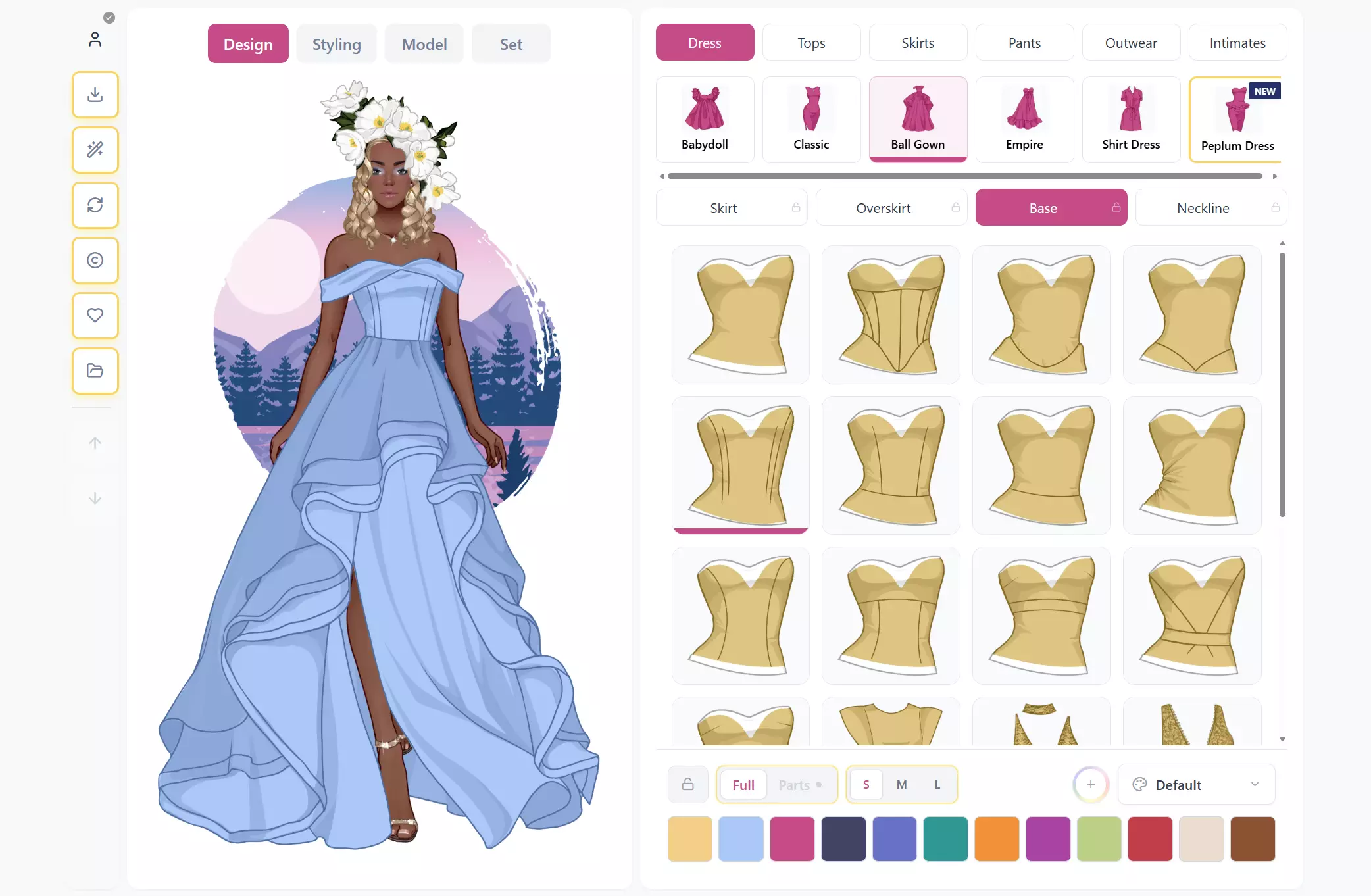
PUM! Fashion Designer is an app we built to help designers struggling with fashion sketches, students, brand owners.
It’s as easy to use as a dress-up game. But it is a powerhouse that helps you generate ideas, switch colorways in seconds, and test different stylings without ever drawing a line. Coherent, professional level illustrations land in your portfolio in seconds.
It’s free to try and accessible on any device without download. The full access costs less than just one illustration done by a professional artist and the art is hand-drawn by professional illustrator, not another AI slop. Try it here.
Moral of the story – don’t slack on the way you present your ideas. Do it whichever way you want, but always put in the effort!
The presentation can not only change the end of your story – it can grant you a story to begin with.
Happy drawing!